Novanectar
Fueling Progress...
Fueling Progress...
Novanectar
Author
04 May 2026
Published
3 min read
Reading time
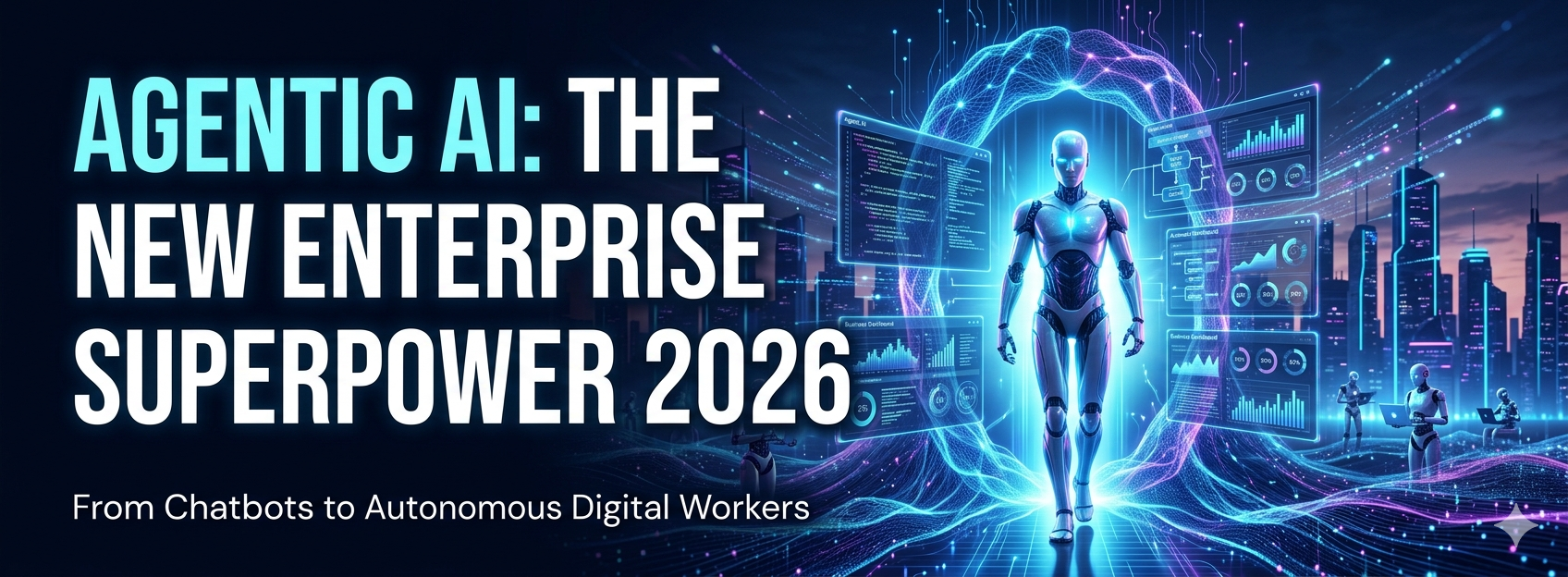
Agentic AI is emerging as the biggest enterprise trend of 2026. Unlike regular chatbots, these autonomous AI agents can plan, reason, and execute complex multi-step tasks independently — from coding to deploying full applications.
May 4, 2026 — The business world is witnessing a major shift from generative AI chatbots to Agentic AI— autonomous systems that can plan, reason, make decisions, and execute complex tasks with minimal human supervision. This marks the biggest transformation in enterprise technology this year.
Unlike traditional AI that only generates text or images, Agentic AI acts as an independent digital worker. It can break down goals into steps, use tools, interact with systems, handle exceptions, and complete end-to-end workflows. Think of it as giving AI “hands and legs” to act in the real digital world.
Two big announcements are accelerating this shift:
Microsoft Agent 365 went generally available on May 1, 2026. It serves as a central “control plane” for managing, securing, and governing hundreds or thousands of AI agents across an organization. Enterprises can now deploy, monitor, and control both Microsoft and third-party agents at scale with proper governance.
Cloudflare + Stripe launched a new open protocol that lets AI agents autonomously create accounts, buy domains, process payments, and deploy full applications — all without human intervention in the loop. This removes major friction points and enables true zero-to-production autonomy for AI agents.
The numbers show explosive momentum:
The Agentic AI market is projected to grow from $7.6 billion in 2025 to $10.8 billion in 2026.
Gartner predicts that by the end of 2026, 40% of enterprise applications will include task-specific AI agents (up from less than 5% in 2025).
Many large organizations already run 1,000+ agents in production.
Salesforce’s Agent force platform has seen massive adoption with over 18,000 customers and strong revenue growth.
Industries leading the charge include finance (KYC/AML automation), customer service, software development, retail, and HR.
Companies using Agentic AI are reporting dramatic gains:
200% to 2,000% productivity improvements in certain workflows
Significant cost reduction in operations
Faster decision-making and 24/7 autonomous execution
Instead of employees doing repetitive tasks, they now supervise and train their AI agents — creating a hybrid human-AI workforce.
Despite the excitement, hurdles exist. Only a small percentage of pilots reach full production due to issues around security, data access, governance, error handling, and integration with legacy systems. Companies must focus on strong guardrails, monitoring, and clear accountability before scaling.
2026 is shaping up as the inflection year for Agentic AI. From Microsoft’s governance tools to Cloudflare-Stripe’s autonomous deployment capabilities, the infrastructure for large-scale agent adoption is now falling into place.
For businesses in India and globally, the message is clear: Organizations that learn to build, deploy, and manage Agentic AI effectively will gain massive competitive advantage in speed, efficiency, and innovation. Those that delay risk falling behind.
The era of AI as a simple assistant is ending. The age of autonomous AI colleagues has begun.
Published on 04 May 2026
Last updated: 04 May 2026