Novanectar
Fueling Progress...
Fueling Progress...
Novanectar
Author
30 June 2026
Published
4 min read
Reading time
Discover proven business strategies for 2026 that top Indian companies are using to thrive amid AI disruption, economic shifts, and global competition. Practical insights for leaders and entrepreneurs.
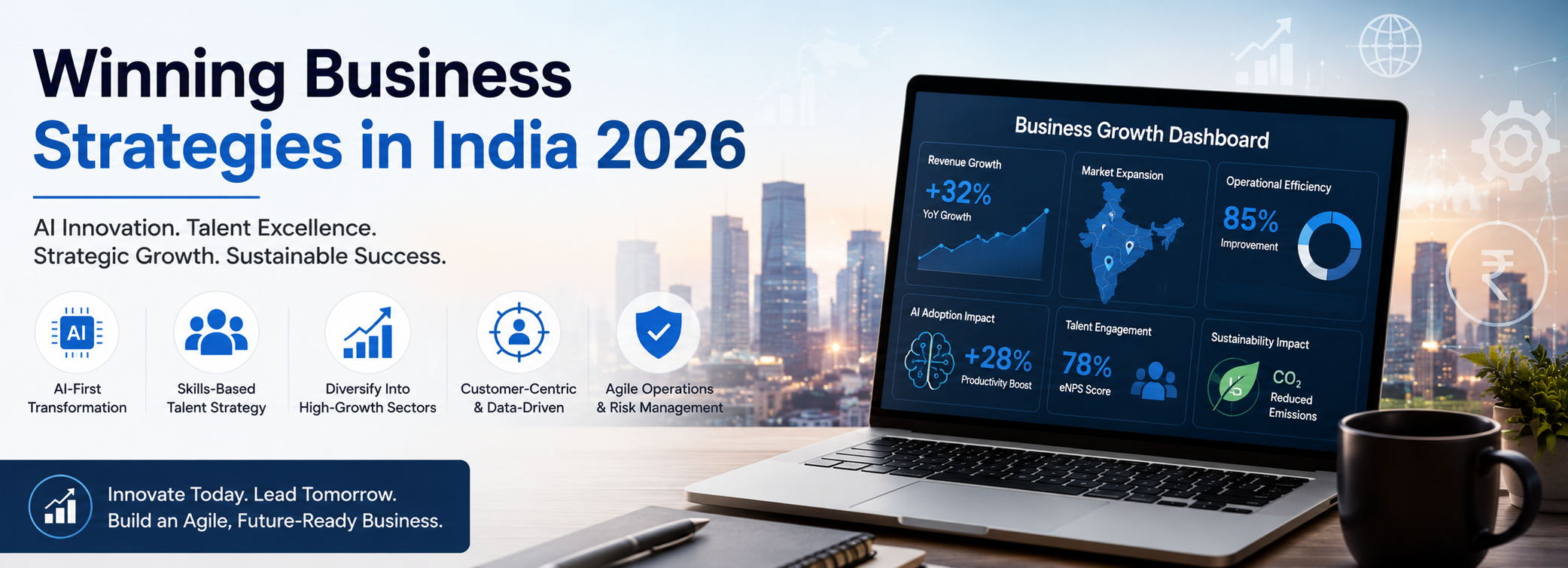
In 2026, the Indian business landscape is more dynamic and competitive than ever. Rapid technological advancements, shifting consumer behaviors, and global uncertainties demand agile, forward-thinking business strategies. Companies that embrace AI, focus on talent optimization, and expand strategically into new markets are not just surviving—they are dominating. This comprehensive guide explores the key business strategies driving success across India this year.
Artificial Intelligence is no longer optional—it's the core of winning business strategies in 2026. Indian enterprises are rapidly integrating AI across operations, from customer service chatbots and predictive analytics to automated supply chains and personalized marketing.
Leading firms are deploying AI agents alongside human teams, as highlighted by TCS leadership discussions on balancing workforce with intelligent systems. This approach improves efficiency, reduces costs, and allows companies to scale without proportional headcount increases. Businesses adopting AI report higher productivity and better decision-making, creating a significant edge over slower competitors.
Actionable Tip: Start with pilot projects in high-impact areas like demand forecasting or cybersecurity. Invest in employee upskilling to ensure smooth adoption rather than resistance.
Talent remains a critical pillar of business strategy. With hiring trends favoring specialized skills, successful companies are moving beyond traditional degrees to skills-first hiring. Global Capability Centers (GCCs) have become a strategic powerhouse, employing millions and generating billions in revenue while bringing global best practices to India.
Businesses are aggressively setting up or expanding GCCs in Tier-2 cities to tap into cost-effective, high-quality talent pools. This decentralization strategy reduces dependency on metros, lowers operational costs, and supports government initiatives for balanced regional growth.
Moreover, 73% of employers plan fresher hiring in 2026, but with a twist—structured training programs turn fresh talent into immediate contributors. Companies offering clear career paths, hybrid work, and continuous learning opportunities enjoy lower attrition and higher engagement.
Smart business leaders are diversifying into high-growth sectors such as renewable energy, electric vehicles (EV), e-commerce logistics, healthcare tech, and fintech. Non-IT sectors have shown impressive hiring and revenue growth, providing buffers against IT cyclical slowdowns.
Case in Point: Hospitality, real estate, and education sectors recorded double-digit growth. Companies that invested early in sustainable practices and digital platforms are reaping rewards through new revenue streams and government incentives.
In an era of abundant choices, businesses winning big prioritize deep customer insights. Leveraging big data and AI analytics helps companies anticipate needs, personalize experiences, and build loyalty. Pay transparency, ethical practices, and strong ESG (Environmental, Social, Governance) commitments are also becoming key differentiators for brand reputation and talent attraction.
Volatility in global markets requires flexible business models. Successful strategies include:
Adopting hybrid/cloud infrastructure for scalability.
Building resilient supply chains with local sourcing.
Using scenario planning and real-time dashboards for quick pivots.
Exploring gig economy and flexible workforce models to manage demand fluctuations.
Tier-2 and Tier-3 city expansion is a major trend, offering lower costs, loyal talent, and access to emerging consumer bases.
Innovation Culture: Encourage experimentation and fail-fast learning.
Sustainability Integration: Align business goals with climate and social impact.
Partnerships & Ecosystems: Collaborate with startups, academia, and tech providers.
Metrics That Matter: Move beyond revenue to track customer lifetime value, employee net promoter score (eNPS), and innovation pipeline strength.
Companies following these strategies are seeing stronger financial performance, better talent retention, and market leadership. For SMEs and startups, focusing on niche markets and leveraging digital tools levels the playing field against larger players.
India’s economy is poised for robust growth, with projections of millions of new jobs and opportunities fueled by digital transformation. Businesses that treat strategy as an ongoing, adaptive process—rather than a static plan—will capture the most value in 2026 and beyond.
Whether you run a startup, manage a mid-sized firm, or lead a large corporation, integrating AI, talent excellence, diversification, and customer obsession will be your roadmap to sustainable success.
The message is clear: In 2026, the winners won’t be those who predict the future perfectly, but those who build organizations agile enough to shape and thrive in it.
Published on 30 June 2026
Last updated: 30 Jun 2026