Novanectar
Fueling Progress...
Fueling Progress...
Novanectar
Author
12 July 2026
Published
3 min read
Reading time
Africa CDC says the Bundibugyo Ebola outbreak in DR Congo is spreading faster than any recorded outbreak, with 1,759 cases and 600 deaths as containment efforts struggle to keep pace.
The Ebola outbreak sweeping through the Democratic Republic of Congo has become the fastest-growing on record, according to African health authorities. Officials confirmed this week that the virus is spreading at a pace that has outstripped even the deadliest Ebola epidemic in history.
The outbreak, first declared in mid-May, has already claimed hundreds of lives across four provinces. Health workers are racing to contain a virus strain that has no approved vaccine or treatment.
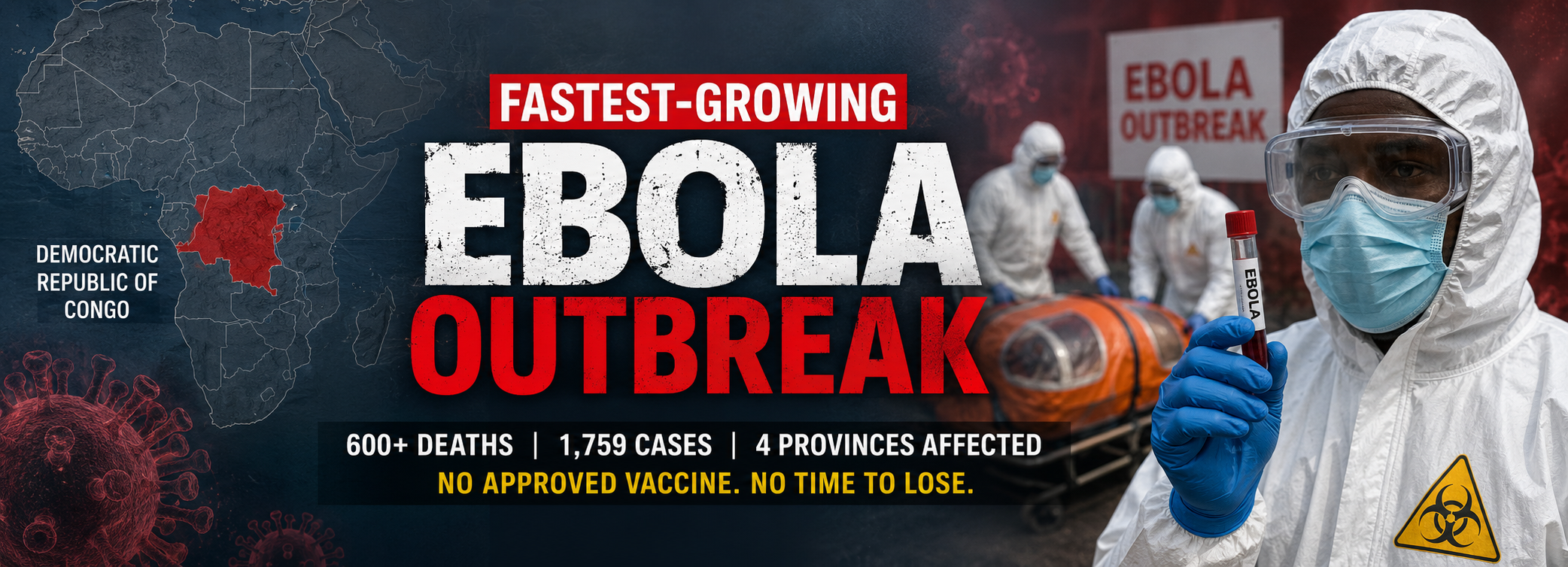
African health authorities said Thursday the Ebola outbreak in Democratic Republic of Congo is the "fastest growing" ever, as the World Health Organization reported it had killed 600 people. Updated figures showed 1,759 confirmed cases in Congo since the outbreak was declared in mid-May, including 600 confirmed deaths.
Africa CDC's Wessam Mankoula said the deadliest Ebola outbreak on record, the 2013–16 West Africa epidemic, saw 994 cases in its first six weeks, compared with 1,596 cases in the current outbreak over a similar span, and that case numbers were estimated to be doubling every 28 days. This outbreak surpassed 1,000 confirmed cases within 40 days of response activation, compared with roughly 235 days for the 2018 North Kivu outbreak.
1,759 confirmed cases and 600 confirmed deaths have been recorded in DR Congo since mid-May
The outbreak has a case fatality rate of 34 percent, with 285 patients recovered and 304 suspected cases still under investigation
The outbreak is caused by the Bundibugyo virus, a rare Ebola species with no approved vaccine or treatment
Clinical trials of the monoclonal antibody MBP134 and the antiviral remdesivir began in DR Congo on July 2
Uganda has reported cases limited to its capital, Kampala, with no community spread and its last case tied to travel from DR Congo
The WHO has sought $115 million to strengthen its Ebola response, of which only about 32 percent had been received as of early July
The outbreak now constitutes the third-largest Ebola outbreak on record, underscoring how quickly the disease can spread when detection is delayed. Experts note the virus likely circulated undetected since around February, but health ministries did not declare an outbreak until mid-May.
Declining global humanitarian aid, the loss of USAID, and a diminished international role for the U.S. CDC have raised concerns about whether the response can be adequately funded and staffed. One affected province, South Kivu, has also seen clashes between Congolese forces and the M23 armed group, complicating relief efforts.
"This is the fastest-growing Ebola outbreak ever, not only among the previous Bundibugyo outbreaks, but all the different viruses that are causing Ebola," said Wessam Mankoula, head of emergency preparedness and response for the Africa CDC. He added, "Unfortunately, the virus is still ahead of our response. It's moving faster than deploying the resources to control the situation," and said $1.4 billion was needed in total for the disease and humanitarian response.
Tom Fletcher, head of the UN's humanitarian operations, said, "Before Ebola struck, millions were already facing conflict, hunger, displacement, weak basic services and limited healthcare. DRC is one of the world's most complex humanitarian crises."
Health authorities are expanding laboratory testing capacity and continuing clinical trials of experimental treatments. Funding shortfalls remain a critical concern, and officials are calling for greater international support to scale up contact tracing and containment efforts before the outbreak spreads further.
The Ebola outbreak in DR Congo has reached a grim milestone, becoming the fastest-spreading in recorded history. While treatment trials are underway and testing capacity has improved, response efforts continue to lag behind the virus's spread, leaving global health officials urging faster and better-funded intervention.
Published on 12 July 2026
Last updated: 12 Jul 2026