Novanectar
Fueling Progress...
Fueling Progress...
Harshait | Novanectar
Author
19 March 2026
Published
4 min read
Reading time
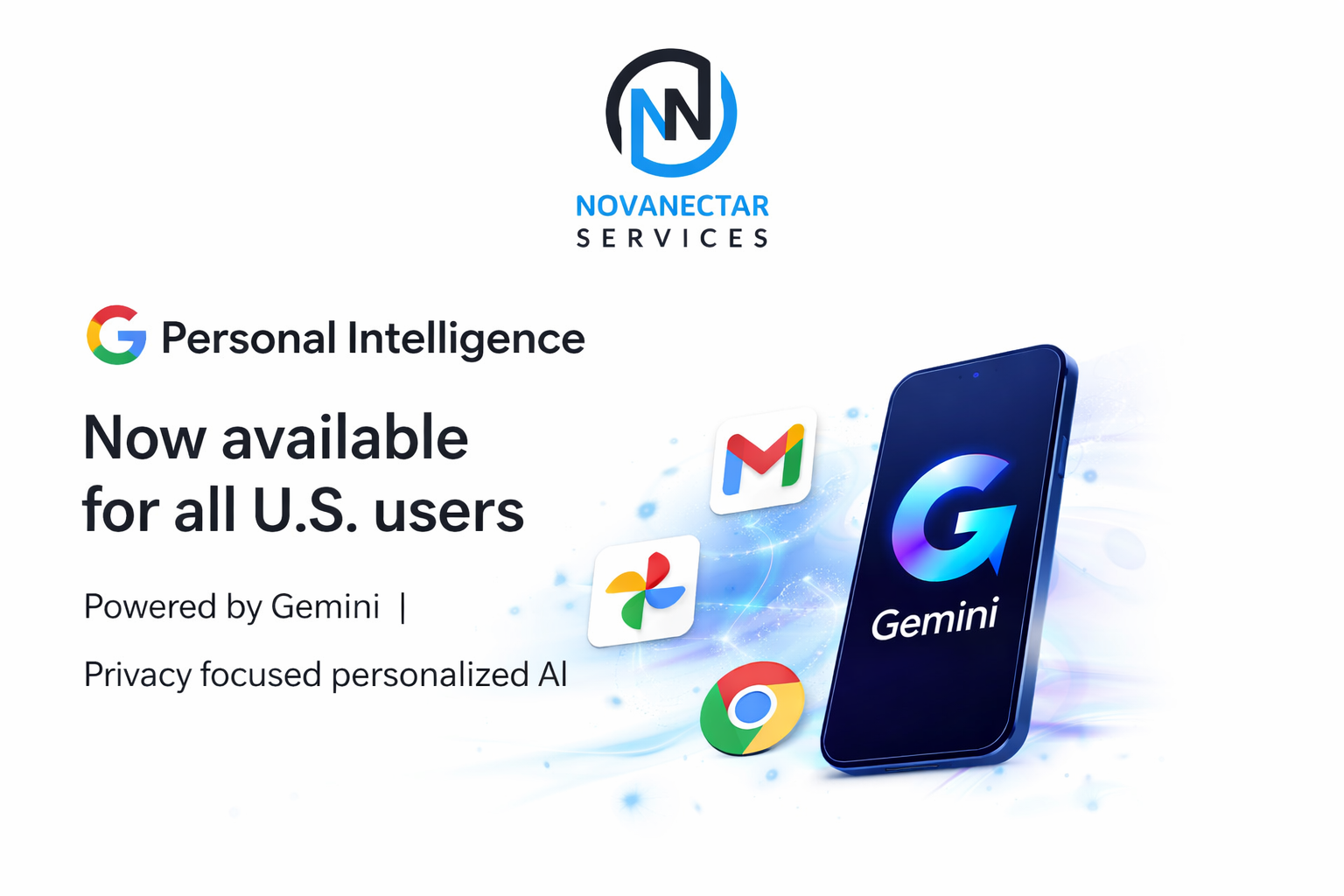
Google expands Personal Intelligence to all U.S. users, making AI assistants smarter and more personalized. Powered by Google Gemini, it connects Gmail, Photos and Chrome to deliver context-aware results while maintaining strong privacy controls.
In a significant move to enhance personalized AI experiences, Google has officially announced the expansion of its Personal Intelligence feature to all users across the United States. Previously limited to paid subscribers, this advanced capability is now being rolled out for free-tier users, marking a major step in making AI more accessible and context-aware.
Personal Intelligence is a smart feature designed to make AI assistants more helpful by connecting them with a user’s personal Google ecosystem. This includes services like Gmail, Google Photos, and browsing behavior within Chrome. By leveraging this data (with user permission), the AI assistant powered by Gemini can deliver more relevant and tailored responses without requiring users to repeatedly provide context.
The feature is currently available within AI Mode in Search, the Gemini app and Gemini integrated into Chrome, creating a seamless experience across platforms.
Unlike traditional AI assistants that rely solely on prompts, Personal Intelligence enhances responses by understanding user habits, preferences and past activities. For example:
If you’re searching for a product you’ve previously purchased, the AI can quickly identify it without needing detailed input.
Planning a vacation becomes easier as the AI can analyze hotel bookings from Gmail and travel memories from Google Photos to suggest customized itineraries.
Even fashion recommendations improve, with suggestions tailored to your past purchases, preferred brands and style choices.
This level of personalization allows users to save time while receiving highly relevant suggestions that align with their lifestyle.
Recognizing the importance of user privacy, Google has emphasized that Personal Intelligence is turned off by default. Users must actively choose to enable the feature and decide which services they want to connect.
Additionally, Google clarified that its AI models do not directly train on personal data such as Gmail inboxes or photo libraries. Instead, the system learns from user interactions within specific prompts and responses, ensuring a layer of data protection and transparency.
The true value of Personal Intelligence lies in its practical applications:
Shopping Assistance: If you recently bought shoes, the AI can recommend matching accessories, considering details like color and style.
Travel Planning: By analyzing past trips and current bookings, the assistant can suggest activities suited to your preferences and family interests.
Daily Convenience: Forgetting details like tire size or past purchases becomes less of an issue, as the AI can retrieve and infer information instantly.
These capabilities highlight how AI is evolving from a general tool into a personalized digital assistant.
As of now, the feature is available only to users in the United States and is limited to personal Google accounts. It is not yet accessible for Workspace, enterprise, or educational users, indicating that broader rollout may happen in future phases.
The rollout has already begun for AI Mode in Search, with gradual availability expanding to the Gemini app and Chrome integration.
With this update, Google is clearly pushing toward a future where AI becomes deeply integrated into everyday life. By combining personalization with privacy controls, the company aims to strike a balance between convenience and user trust.
As AI continues to evolve, features like Personal Intelligence could redefine how users interact with technology making digital assistants not just smarter, but truly personal.
Published on 19 March 2026
Last updated: 09 Apr 2026