Novanectar
Fueling Progress...
Fueling Progress...
Novanectar
Author
27 May 2026
Published
3 min read
Reading time
Health authorities confirm two Nipah virus cases in West Bengal. The deadly virus has high fatality rate but outbreak appears contained with no further spread reported.
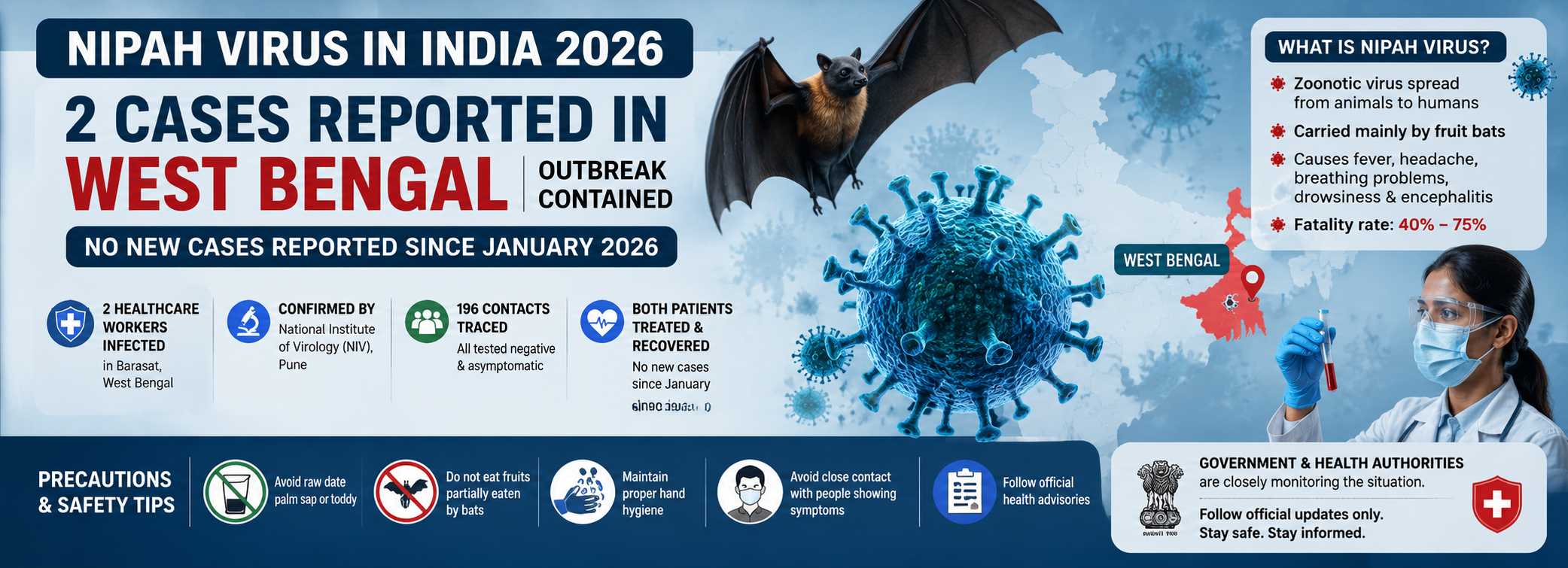
New Delhi, May 27, 2026 – Indian health authorities are closely monitoring the situation after two confirmed cases of Nipah virus (NiV) were reported in West Bengal earlier this year. While the cases raised concerns across the country, officials have confirmed that the outbreak has been successfully contained with no new infections reported since January 2026.
Two healthcare workers at a private hospital in Barasat, North 24 Parganas district, tested positive for Nipah virus.
The cases were confirmed by the National Institute of Virology (NIV), Pune.
Around 196 contacts were traced, tested, and monitored. All tested negative and showed no symptoms.
Both patients received treatment and recovered under medical supervision.
No additional Nipah virus cases have been reported since January 2026.
Nipah virus is a dangerous zoonotic virus that spreads from animals to humans. Fruit bats are considered the main carriers of the virus. Infection may occur through contaminated food, infected animals, or close contact with infected individuals.
The virus can cause:
Fever
Headache
Breathing problems
Drowsiness
Brain inflammation (encephalitis)
Health experts say the fatality rate can range from 40% to 75%, depending on the outbreak and healthcare response.
This is the first Nipah virus outbreak reported in West Bengal after nearly 19 years. Earlier outbreaks in the state were recorded in 2001 and 2007.
Following the reports, some Asian countries temporarily increased airport screening for travelers arriving from India as a precautionary measure.
The World Health Organization (WHO) has assessed the global public health risk as low. Officials also confirmed there is no evidence of sustained human-to-human transmission at this time.
Health authorities have advised citizens to follow these preventive measures:
Avoid drinking raw date palm sap or toddy.
Do not eat fruits partially eaten by bats.
Maintain proper hand hygiene.
Avoid close contact with people showing symptoms like fever or breathing difficulty.
Follow official health advisories in affected areas.
Early medical attention is important if symptoms appear after exposure.
Separately, Japanese Encephalitis (JE) cases continue to appear seasonally in states like Assam, Uttar Pradesh, and nearby regions, especially during the monsoon season.
Health experts recommend:
Vaccination
Mosquito control
Clean surroundings
Use of mosquito nets and repellents
These measures can help reduce the spread of JE infections.
The Union Health Ministry is continuously monitoring emerging health threats across the country. State health departments, surveillance teams, and hospitals remain alert to prevent any further spread of infectious diseases.
Citizens are advised to rely only on official government and WHO updates instead of rumors or unverified social media posts.
Two Nipah virus cases were reported in West Bengal in January 2026.
No new cases have been detected after contact tracing and monitoring.
WHO has assessed the global risk as low.
Public safety measures and hygiene remain important.
Authorities continue to monitor both Nipah virus and seasonal JE cases.
Source: World Health Organization (WHO), Union Health Ministry, National Institute of Virology (NIV), and official reports – 2026.
Published on 27 May 2026
Last updated: 27 May 2026