Novanectar
Fueling Progress...
Fueling Progress...
Novanectar
Author
Friday, November 21, 2025
Published
3 min read
Reading time
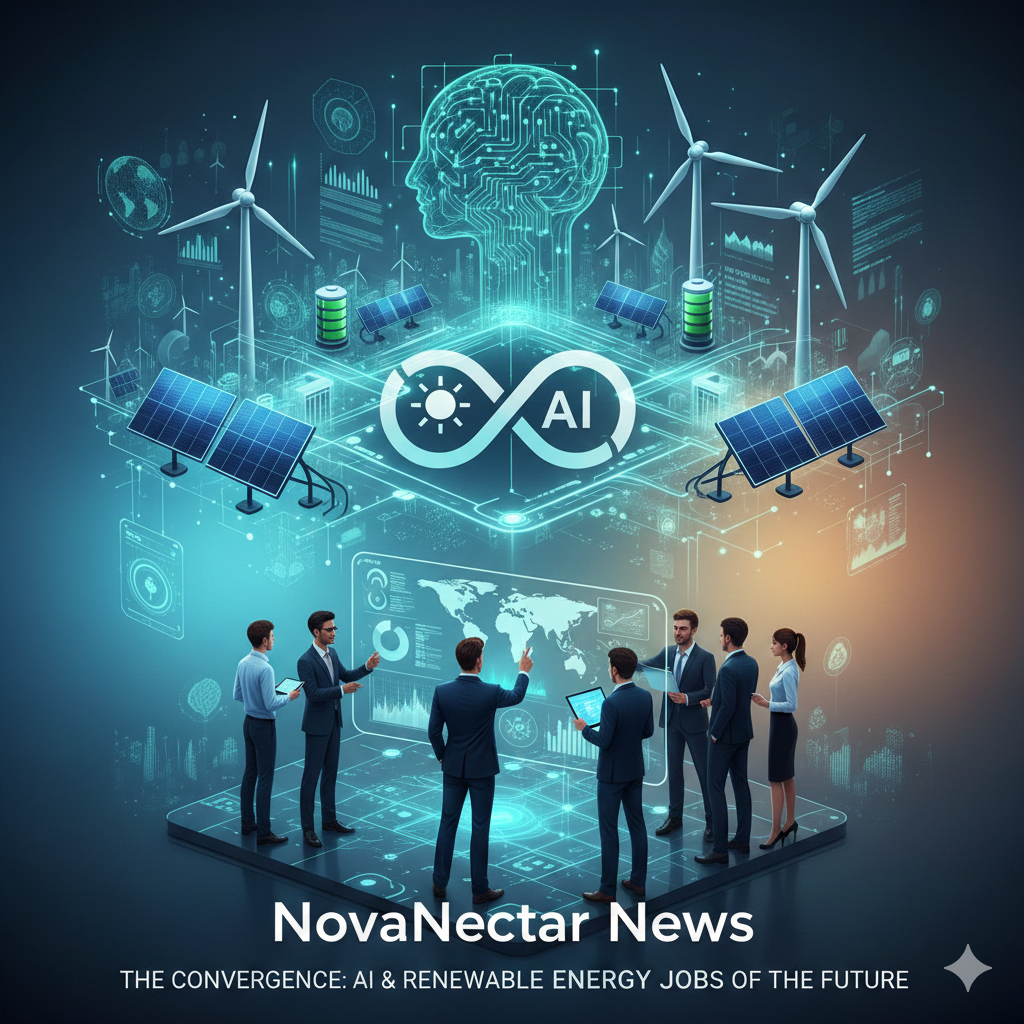
AI is transforming the renewable energy sector through automation, predictive modeling, data analytics and digital tools. Companies now need freshers skilled in software, AI, cloud and data to support new roles like energy analysts, forecasting assistants and solar software engineers.
NovaNectar Services Pvt. Ltd. believes that the future for the global energy sector lies in the convergence of renewable technologies and artificial intelligence. As a part of staying ahead of innovation, our team researches trusted global sources every day to understand how AI is transforming solar, wind and other renewable systems and what this means for upcoming job roles.
Rated Power emphasizes that AI is crucial for the renewable energy industry: it supports predictive maintenance, site design, environmental impact studies, grid management, energy forecasting and risk analysis.
Newer job roles are also emerging with rising automation, such as those combining software skills with renewable energy knowledge, hence appropriate for freshers/early-career professionals.
AI tools include features like Enverus Instant Analyst™ AWS Bedrock–powered systems, solar modeling algorithms and ML-based forecasting engines that help analyze big data sets in seconds. This makes energy planning quicker, more accurate and less resource-intensive compared to manual methods.
For instance, land data validation for solar farms is done today using image recognition powered by AI and ML models forecast real-time wind and solar generation to maintain grid stability. These capabilities are creating strong demand for entry level roles such as:
AI Energy Analyst
Junior Solar Software Engineer
Renewable Data Analyst
Energy Forecasting Associate
Grid Optimization Software Assistant
PV Design Automation Intern
Freshers possessing skills in data analytics, Python, MATLAB, cloud platforms, GIS tools, or simulation software are increasingly getting hired by renewable energy companies, EPC firms, and energy tech-startups.
We at NovaNectar too see the rapid rise of AI-enabled workflows across green-tech and energy tech projects. Our teams now leverage automation, data-driven frameworks and cloud-based dashboards to speed up design, testing and reporting for renewable clients.
In predictive modeling or automation of simulation tasks, project delivery is significantly faster and the results tend to have fewer manual errors, yielding clearer insights for decision making. By hastening project execution, clients can reduce their operational costs and enhance sustainability outcomes.
We are convinced that freshers trained in software development, AI fundamentals, cloud systems or data analytics will provide the crucial underpinning for next-generation renewable innovation. The convergence of energy + software is now one of the most promising career paths.
While AI automates a host of processes, human expertise related to engineering, ethics, safety and environmental judgment remains valuable. The best outcomes arise when technology augments human decision-making not replaces it.
As renewable energy keeps growing and artificial intelligence deepens within the energy system, freshers can get ready for a wave of new tech enabled career opportunities. At NovaNectar we will continue to share such global insights daily to help students, professionals and innovators be prepared for a cleaner, smarter energy future.
Stay tuned for daily tech updates and more on industry trends from NovaNectar News.
Reference: Source – RatedPower (Artificial Intelligence in Renewable Energy) 🔗
Published on Friday, November 21, 2025
Last updated: 11/21/2025